

Book Club: novels about historical murder
In our special Book Club edition of Lady Killers, I rave about the novels of Sarah Waters
This is the exciting week that LADY KILLERS is back on the radio and wherever you get your podcasts!
We have a whole rainbow of different types of killer women for you in the new season: a high-society murderess in 1930s Mayfair, a female body snatcher, and an enslaved woman in Pennsylvania who drowned the children of the people who claimed to own her.
Each case seems more shocking, poignant and compelling than the last.
But the first episode was our special one-off murderous Book Club, which we had the great joy of convening back in the summer with lots of our lovely Lady Killers listeners, live, in a tent, in the pouring rain, at the Hay Festival.
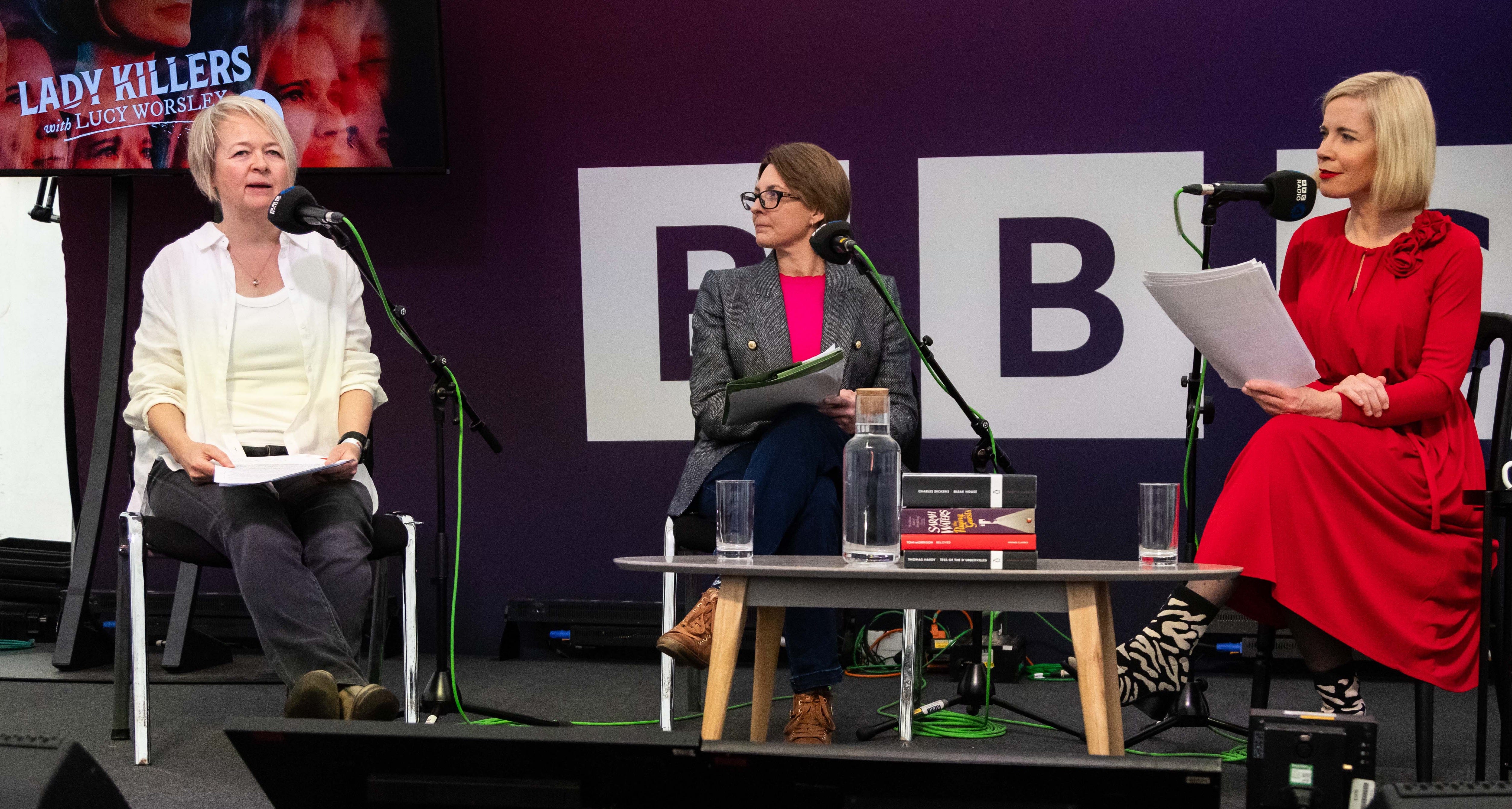
We wanted to dissect novels featuring killer women, and who better to help us than one of my all-time top-favourite novelists, Sarah Waters?*
We were wild to have Sarah in our Book Club, partly because we worship her, but not least because her novel THE PAYING GUESTS has a loose relationship with the real events in the 1922 case of Edith Thompson.
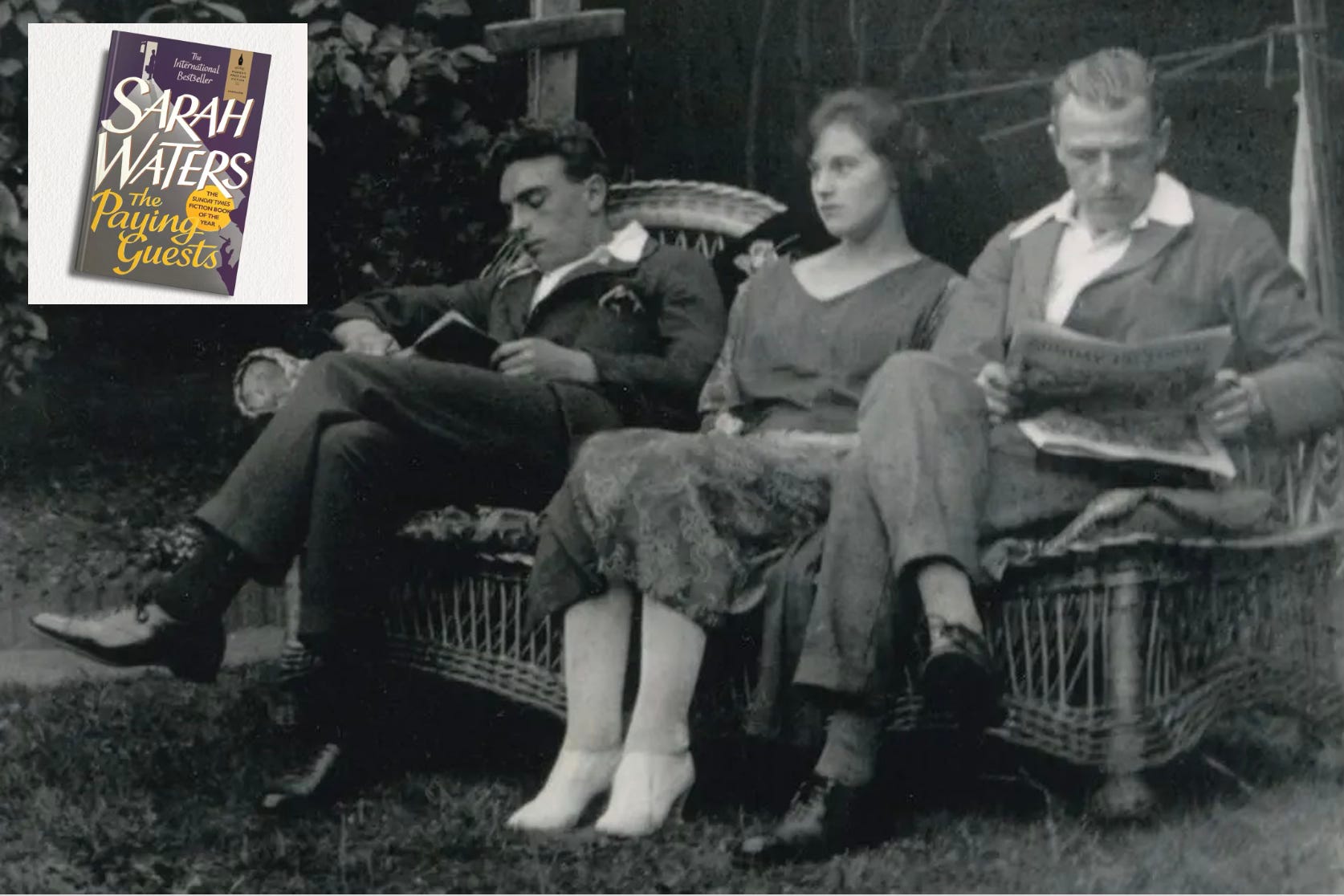
Edith Thompson (of Ilford, East London) was convicted of helping to kill her husband Percy, on the very shaky grounds that she’d written some sexy letters to her lover.
Edith’s lover Freddy stabbed Percy one night on the streets as he walked home.
At the trial, there was a lot of public sympathy for the widowed Edith.
Until, that is, the prosecution produced some sexually explicit letters between Edith and her lover, full of what were seen as depraved fantasies.
Suddenly, it seemed, everyone could now see Edith as an accomplice in the crime. Surely a woman who could write those letters was capable of anything?
Other factors told against poor Edith too. She was one of the rather shocking ‘new women’ who were upsetting old buffers everywhere in the 1920s.
She had a job – a big job, which took her on business trips to Paris – but it was selling hats. Which had a frivolous lack of respectability. Note too the couple’s address: they were from East London, not the fancy West End.
Young, competent, fashionable, and unfaithful to her husband: taken together, the court thought that all this seemed to make her a killer.
There was recently an attempt to get Edith a pardon, on the grounds that so much of her ‘guilt’ rested on the letters she’d written to Freddy.
The commission reviewing the case even listened to the episode of Lady Killers which we devoted to Edith!
But sadly we didn’t manage to convince them, and Edith is still – at least in the eyes of the law – guilty.
Now, in Sarah Waters’ fabulous novel, THE PAYING GUESTS, set in the same period, there’s a similar central love triangle involving a married couple.
But this time of course, because this is a Sarah Waters novel, the wife’s lover is female. And the killing is … well, of course I’m not going to reveal the ending because I don’t want to spoil it for you.
Sarah told us she’d wanted to write a novel that hangs from a striking image she’d had in her mind – of two women carrying a corpse down the stairs.
Yes, how often do you see that in film or fiction? Not often enough!
Sarah explained how in the 1920s the relationship between the two women would have been invisible to society, which would have helped them to commit a crime. But it would also have left them terribly isolated.
Re-reading THE PAYING GUESTS this summer, I was reminded how brilliantly it recreates the lives of middle and lower-middle class people (the distinctions are very important!) in outer London in the 1920s.
The slow burn of the first half is magnificent, building up such a detailed picture of the life of the heroine, a former Suffragette who’s by now basically a maid-of-all-work in a house that’s far too big for herself and her mother.
The cleaning of the tiled floor with vinegar! The lighting of the stove! The laborious peeling of the potatoes!
It’s all so grimily, grindingly realistic.
One of the things I love about Sarah Waters’ books in general is the close relationship they have to the literature being published at the time she’s writing about.
THE PAYING GUESTS is full of the language and customs and consumer goods and feelings of the empty, hollowed-out, post-War period, when people were beginning to realise that they weren’t just going to go back to life as it had been in Edwardian times. And if not that, then … what?
As people say at the end of Book Club meetings: my conclusion is that THE PAYING GUESTS is a historian’s historical novel, the perfect novel for lovers of Lady Killers, and a book I can’t recommend highly enough.
What have you read recently that you’ve enjoyed?
*I’ll tell you a shaming story: I once got to have tea with Sarah Waters because with incomparable kindness, she bought me in a charity auction.
The ‘prize’ offered was to have afternoon tea with me, and when no one else at all was bidding. Sarah saved me from the humiliation of being unsold.
When she came to tea, I was naturally desperate to ask her where she gets her ideas from, and what kind of pen she uses, and all those idiotic things people are burning to ask their favourite novelists.
But I felt that wasn’t at all what she deserved for her kind deed, and I tried really hard to stop myself.
Thank you Lucy, and I wish you and all a Merry Christmas and a healthy New Year
plus Peace for this ol' world. The other evening watched Princes in the Tower on
Cdn. television. To make sure these are the princes in the monument at Westminster
perhaps it would be a good idea to open it up again and test the remains for DNA. All the best, Edna ~ Ottawa
Another book influenced by the Thompson case is A Pin to see the Peepshow by F Tennyson Jesse published in 1934 the final chapters of which reduced me to tears. Recently I have been reading the Tudors based novels of Patricia Finney , Firedrakes Eye, Unicorns Blood & Gloriana's torch. Happy birthday Lucy , just been rewatching Killing Sherlock whilst knitting. Janet